
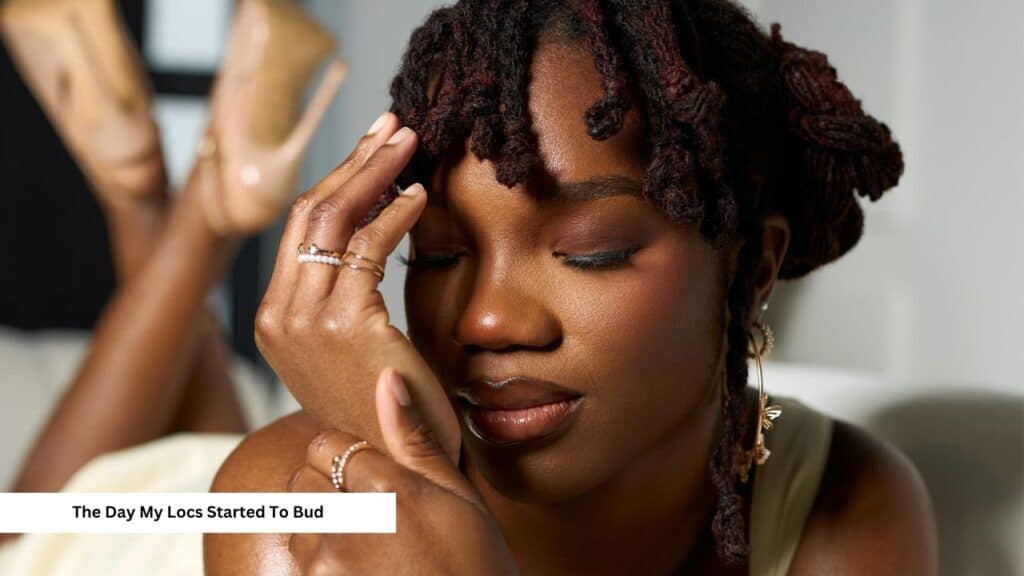
I remember the moment clearly. I was doing my usual post-wash check, running my fingers slowly along each microloc the way you do when you are looking for sections that have combined or ends that need attention, and then I felt it, a small, firm knot sitting about an inch down from my root on a loc near my crown. I pressed it between my fingers to make sure I was not imagining things. It was real. Dense. Unmistakable.
A bud.
I will not pretend I did not make a bigger deal of it than it sounds. After months of wondering if my hair was ever going to do what it was supposed to do, that tiny knot felt like the most significant thing that had happened in a long time because, for me, getting to that moment had not been straightforward. My 4b hair had its own timeline and its own pace, and the months leading up to that first bud had tested my patience in ways I had not fully anticipated.
What I want to share is not just the moment itself but what actually changed in my routine in the weeks and months before it happened, because I do not think the budding was coincidental. I think it was a direct response to shifts I had made, some intentional, and some accidental, that finally gave my hair what it needed to progress.
***Please note that this site uses affiliate links if you would like to read the legal stuff you can find it here
The Long Wait Before the Bud
Let me be honest about the timeline first because I think it matters.
My microlocs were installed on 4b hair, and as I have learned through this journey, that distinction changes everything when it comes to how quickly the locing process moves. The tighter, more uniform coil of 4c hair knots with itself more readily.
My 4b hair, with its angular, Z-shaped bend, needed significantly more time before it was ready to do the same.
For months, my locs looked and felt more or less the same as they had at installation, soft, pliable, and a little frizzy between retwists. There were moments where I squeezed a loc between my fingers, hoping to feel something different, and felt nothing. Just hair. Just waiting.
What I did not understand then, and understand clearly now, is that a lot of the locing process happens inside the strand before it becomes detectable from the outside. The hair is working. You just cannot always feel it yet.
Knowing that would have saved me a significant amount of anxiety during those months. I am telling you now so it saves you some too.
What I Was Doing That Was Getting in the Way
Before I talk about what changed for the better, I need to be honest about what I was doing that was quietly working against my own progress.
I was retwisting too often. Every three weeks, sometimes less, because I could not tolerate the frizz and the way my new growth looked between reties.
What I did not realise at the time was that frequent retwisting was essentially resetting the process each time.
For buds to form, the hair inside the loc needs time to move, shift, and begin to tangle with itself. When I was coming in and smoothing everything back down on a tight schedule, I was undoing the internal work my hair was trying to do.
I was also product-heavy in a way that was not helping.
I had read that moisture was essential, and I had taken that to mean more product, more often. What I actually ended up with was buildup that coated my locs and made it harder for the hair to move and knot naturally.
Moisture is essential, but there is a difference between hydrated locs and product-saturated locs, and I had crossed that line without realising it.
I was also not washing often enough. I had convinced myself that washing too frequently would disturb my locs, unravel my new growth, and set me back. What I was actually doing by washing infrequently was allowing buildup to accumulate and depriving my locs of the gentle friction that wash day provides, friction that actually encourages the locing process.

The Shifts That Changed Everything
Three things changed in the weeks before I felt that first bud, and I believe all three of them contributed.
The first was extending my retwist schedule. I moved from retwisting every three weeks to every six or seven weeks. This was uncomfortable at first because my roots looked untidy and my new growth was visible and unruly. I had to actively talk myself out of booking an earlier appointment multiple times.
Leaving my hair alone gave it the uninterrupted time it needed. The hair inside each loc had weeks rather than days to begin settling and working toward structure.
The second was washing more consistently and with less fear. I started washing every two/ three weeks using a diluted clarifying shampoo, and working it gently through my locs and scalp without aggressively smoothing or manipulating the hair back into place afterward.
I let my locs air dry without interference. The difference in how my hair felt after a few weeks of this was noticeable. It felt lighter, cleaner, more alive somehow. Product residue I had not even realised was there had been cleared out, and my hair was moving differently.
The third shift was the least obvious but possibly the most significant: I stopped touching my hair between wash days.
No daily checking. No constant squeezing and prodding to feel for progress. No re-smoothing frizzy sections with my fingers. I wore my hair, protected it at night with my satin bonnet, hydrated my scalp lightly a couple of times a week, and other than that, I left it alone.
That level of non-interference was new for me, and I think it was exactly what my locs had needed all along.
What Budding Actually Feels Like on 4b Microlocs
I want to describe this specifically because the way budding is often described online did not fully match my experience, and I think that is partly a 4b versus 4c thing.
On 4c hair, buds can sometimes be visible, a visible swelling or gathering along the loc shaft. On my 4b microlocs, the first buds were entirely tactile. I could not see them. I could only feel them. Small, firm, distinct points along the shaft that were not there before. They felt almost like tiny beads sitting inside the loc. Not painful. Not alarming. Just present in a way that the rest of the loc was not.
They did not appear evenly across every loc at the same time. Some sections budded first. Others took weeks longer. The locs closest to my crown and the back of my head seemed to progress first. My edges and the locs around my hairline moved more slowly, which makes sense given that the hair in those areas is finer and more delicate.
If you are feeling for buds and not finding them uniformly across your head, that is normal. Look for the sections that are further along and let them encourage you that the rest is coming.
Final Thoughts On The Day My Locs Started To Bud
The budding phase is not something you can force. You cannot manipulate your way to it or product your way to it. You can only create the right conditions and then step back and allow it to happen in its own time.
For 4b microlocs, those conditions are cleaner hair washed more regularly, less product and less buildup, longer gaps between retwists, and significantly less handling between maintenance appointments.
None of these things are complicated. They are just counterintuitive when you are anxious about progress and every instinct is telling you to do more.
Do less. Wash more. Retwist less often. Leave it alone.
That is what changed. That is what I think made the difference, and on the day I finally felt that first bud, that small, firm, undeniable sign that my locs were doing exactly what they were supposed to do, every month of patience made complete sense.
Yours is coming. Stay the course.
Related posts:
How to tell if you have product buildup
Why scalp buildup is a problem if you leave it
The loc stage that almost made me cut them off