Before I had locs, I spent a long time thinking about having locs. That in-between space, wanting something but not being certain enough to fully commit to it, is somewhere a lot of people sit for longer than they expect.
Locs feel permanent in a way that most hairstyle decisions do not. They carry weight. They invite opinions. They ask something of you before you even begin.
The question I kept circling back to was a simple one, what if I start them and realise they are not for me?
Most of the advice I encountered assumed that the answer to that question was to find a good loctician, book a consultation, and commit. The loc community is, understandably, enthusiastic about professional starts. A loctician brings expertise, consistency, and the kind of even sectioning and sizing that is genuinely difficult to achieve on yourself. All of that is true and worth acknowledging.
It is also true that walking into a salon and paying for a professional loc installation carries a certain psychological weight.
Once someone else has done the work, once you have sat in that chair and invested that money and walked out with your new starter locs, the bar for changing your mind rises significantly. That felt like pressure I was not ready for.
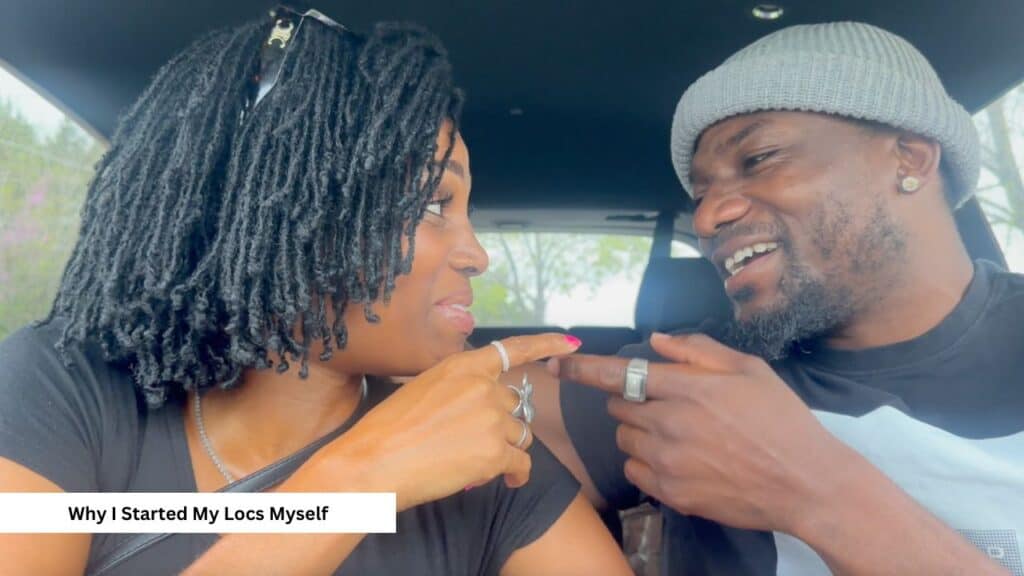
So I did something that made complete sense to me at the time, even if it is not the advice you will find most often, I started my locs myself.
***Please note that this site uses affiliate links if you would like to read the legal stuff you can find it here
The Logic Behind Installing My Own Microlocs
My reasoning was straightforward. If I used two-strand twists that I put in myself and decided after a few weeks or months that locs were not the right path for me, I could take them out. No guilt. No sunk cost weighing on the decision. No feeling that I had wasted a loctician’s time or my own money on something I was abandoning.
The two-strand twist as a loc starter method is particularly well suited to this kind of tentative beginning because it is reversible in the early stages in a way that some other methods are not.
Before the twists begin to truly loc and the hair starts to knot and bind together, they can be unravelled with patience and the right conditioner. The exit route is real. It is not painless, but it exists.
That exit route was not just a practical consideration. It was a psychological one too. Knowing I could change my mind without consequence made it easier to actually begin. The decision to start felt smaller, more manageable, less like a statement about who I was going to be for the next decade and more like a genuine experiment I was running with my own hair.
As it turned out, I did not need the exit route. The twists began to loc, I liked what I saw, and I kept going. The locs I have now grew from the decision I made on my own, in my own space, on my own terms.
How I Did My Own Two-Strand Twists
Starting two-strand twists at home does not require professional training, but it does require patience, a plan, and a realistic understanding of what you are working toward.
The process begins with clean, freshly washed hair. Buildup and product residue from previous styling can interfere with the locking process, so starting with a clarified, clean base matters more than most people initially realise.
Sectioning is the part that takes the most time and has the most impact on how your locs will eventually look. The size of each section determines the thickness of the finished loc.
Larger sections produce thicker locs; smaller sections produce thinner ones. There is no universally correct size, but consistency across the head is worth working toward because unevenly sized sections tend to produce locs that develop at different rates and look visibly mismatched as they mature.
Once your hair is sectioned, the twist itself is simple. Divide the section into two strands and wrap them around each other from root to tip, maintaining consistent tension without pulling so tightly that the root is under stress.
A small amount of a lightweight holding product can help the twist stay defined, though less is genuinely more at this stage. I personally did not use anything except a little leave in conditioner after washing.
Working in small sections, taking your time, and not rushing the process makes a significant difference in the end result. My first attempt took several hours. It was imperfect.
The sections were not as even as a loctician would have made them. The twists at the back of my head, where I could not easily see what I was doing, were looser than the ones at the front. None of that mattered as much as I feared it would.
What the First Few Weeks of My Microlocs Looked Like
The early weeks after starting two-strand twists yourself have a specific quality that is worth being prepared for. The style looks intentional at first. The twists are defined, and the hair behaves in the way a style is supposed to behave. Then, gradually, things start to shift.
The ends begin to unravel slightly. The roots start to feel softer and looser as new growth comes in. The neat, fresh look of the first few days gives way to something in between a style and a commitment, and that in-between quality is exactly where the decision gets made.
For me, that in-between period was when I realised I was not looking for the exit route. I was looking at what was happening at my roots, the way the hair was beginning to knot and coil on itself, the early evidence of something forming, and I was curious rather than uncertain.
The experiment answered the question I had been asking. The answer was that I wanted to keep going.

What Self-Starting Teaches You That a Salon Cannot
There is something that happens when you start your own locs that a professional installation, however excellent, does not quite replicate. You develop an intimacy with your hair from the very beginning of the journey.
When you have done the sectioning yourself, you know where every part sits.
When you have twisted each section by hand, you know which areas of your scalp are tender and which are not, which sections are thicker than others, where your growth pattern does something unexpected. You arrive at your own loc journey having already paid close attention to your hair in a way that many people do not experience until much later.
That early attention paid dividends throughout the rest of my journey.
Decisions about maintenance, about products, about how often to retighten, were all informed by a baseline knowledge of my own hair that I had built from the very first day. Self-starting is, among other things, an education.
The Honest Limitations of Starting Yourself
Honesty matters here. Starting your own locs is not the right choice for everyone, and presenting it as universally superior to a professional start would be misleading.
The sectioning and sizing that a skilled loctician achieves is genuinely difficult to replicate on your own head of hair, particularly at the back and crown of the head.
Uneven sections can lead to locs that merge together as they mature, creating thicker, unintended combinations that require professional intervention to separate.
A loctician also brings an experienced eye that can assess your specific hair texture and recommend the most appropriate starting method, something that self-research, however thorough, cannot fully replace.
If you are certain about locs, if the question is not whether but how, a professional start is worth serious consideration. The expertise is real, and the results show it.
The case for starting yourself is specifically the case for starting yourself when you are not yet certain.
When the commitment feels too large to make cleanly. When you need a way to try before you decide. In that specific situation, two-strand twists done at home are a genuinely reasonable place to begin.
Final Thoughts on Why I Started Locs Myself
If you are where I was before I started, wanting locs but not sure enough to fully commit, the answer is not necessarily to wait until the certainty arrives. Sometimes certainty comes from doing, not from deciding.
Starting your own two-strand twists costs you very little. Your time, your patience, and a lightweight holding product. If you try them and realise within a few weeks that locs are not for you, you unravel them and move on without regret. If you try them and find yourself, as I did, watching the early signs of locking with something that feels like recognition, you keep going.
The loc journey I have now begun with a low-stakes decision made in my own bathroom with no professional guidance and no certainty about the outcome.
It turned out to be one of the best hair decisions I have ever made. Not because doing it yourself is inherently better, but because it was the version of beginning that was right for where I was at the time.
Starting is the part that matters.
Related posts:
Why I stopped retightening my locs so often
Why my 4b locs are taking longer to loc than expected
The microloc journey nobody shows you on instagram