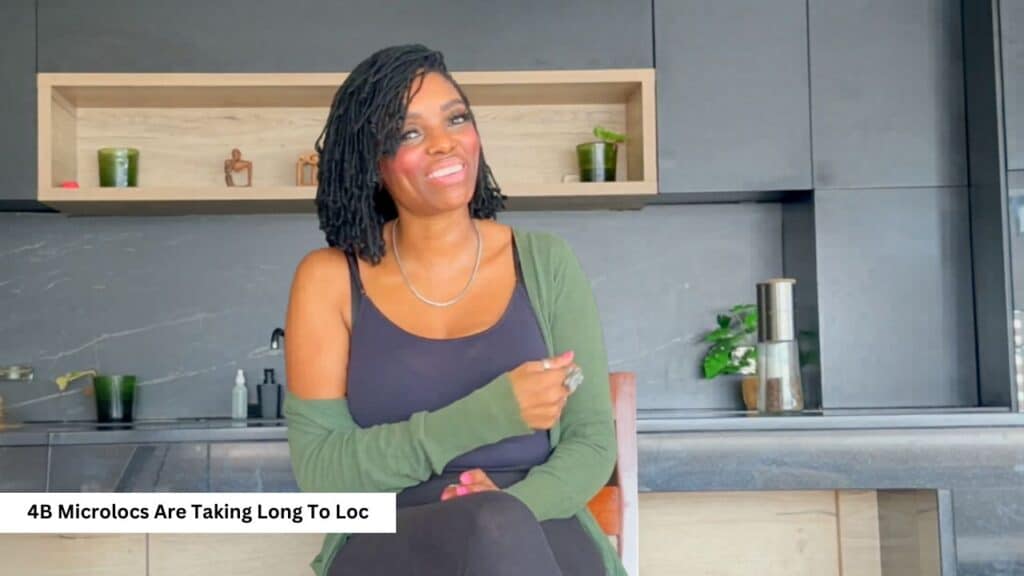
When I started my microloc journey I had a rough idea of what to expect. The stages, the timeline, the awkward phases. I had done my research. I had watched the videos. I felt reasonably prepared.
What I was not fully prepared for was how differently 4b hair behaves in the locing process compared to what I kept seeing documented online.
Most of the microloc content that circulates widely features 4c hair, the tighter, rounder coil pattern that tends to knot and loc more quickly. My 4b hair had different ideas. My timeline looked nothing like what I had been using as a reference point, and for a while I genuinely did not know if something was wrong or if I simply needed to be more patient.
It turned out to be patience, but I wish someone had explained why.
If your 4b microlocs feel like they are taking forever to progress, this is the article I needed and could not find.
***Please note that this site uses affiliate links if you would like to read the legal stuff you can find it here
Why 4b Hair Locs Differently Than 4c
Understanding this starts with understanding the difference between the two textures, because they are genuinely distinct in ways that matter for the locing process.
4c hair has a very tight, densely packed coil with a lot of natural shrinkage and significant curl overlap. That overlap means the hair knots and tangles with itself relatively readily, which is exactly what the locing process requires. The coils interlock naturally, buds form quickly, and the locing process tends to move at a pace that matches the timelines most commonly referenced online.
4b hair has a tighter Z-shaped or angular bend rather than a defined round coil. It is dense and it shrinks significantly, but the curl pattern is less uniform and the strands do not overlap and knot in quite the same way. This means that locing, which is essentially a controlled, intentional matting process, takes longer to initiate and progress for 4b hair.
The hair is not doing anything wrong. It is just working with a different architecture.
This distinction matters because most of the microloc timelines you will find online are built around 4c experiences. Using those as your benchmark when you have 4b hair is setting yourself up for unnecessary anxiety.
What Is Actually Normal for 4b Microlocs
The budding phase, where small knots and tangles form inside the loc, creating the foundation of its structure, can take noticeably longer for 4b hair than for 4c. Where some people with 4c hair see budding within the first few months, 4b hair may take six months or longer before budding is clearly visible or consistently felt along the shaft.
This is normal. It is not a sign that your locs are failing or that your installation was done incorrectly.
The teenage phase, which for 4c hair can feel like it lasts six months to a year, may extend beyond that for 4b hair. Your locs may feel soft and pliable for longer before they firm up and begin to feel more established. Some sections will progress faster than others, this is also normal.
4b hair does not loc evenly across every section at the same rate, and trying to force uniformity through excessive manipulation will slow things down rather than speed them up.
The ends are typically the last part of any loc to seal, and with 4b microlocs this can feel even more true.
Ends that continue to unravel or look loose long after your mid-shaft has begun to loc are not a cause for alarm. They need more time and less interference.
The Things That Were Slowing Mine Down
Looking back, there were a few things I was doing, or rather not doing, that were working against my timeline, and I want to be honest about them.
I was retwisting too frequently. In the early stages I was nervous about the frizz and the unravelling of my locs, so my response was to retwist more often to keep things looking neat. What I did not understand at the time is that frequent retwisting actually interrupts the locing process.
For locs to form, the hair needs time to settle, move, and begin to knot on its own between manipulation sessions.
Retwisting every two to three weeks was smoothing out the progress that was quietly trying to happen in between.
I was also avoiding washing my hair as often as I should have, again out of fear of disrupting the locs and making them unravel. In reality, clean hair locs more effectively than product-laden, buildup-coated hair.
The friction created during a proper wash day, gently working through your locs with shampoo, actually supports the locing process rather than hindering it. Dirty hair just sits. Clean hair moves toward structure.
What I Changed and What Actually Helped
Extending my retwist schedule to every six to eight weeks was the single most impactful change I made. Allowing my new growth time to move and settle without interference gave my locs the space they needed to progress. The frizz between re-ties became something I learned to see as part of the process rather than a problem to fix.
Washing more consistently, every two weeks, also made a visible difference. Using a residue-free shampoo diluted slightly, working it gently through my locs and scalp, and allowing my hair to move naturally during the wash without aggressively smoothing everything back immediately gave my locs the environment they needed.
I also stopped comparing my timeline to anyone else’s, which sounds simple and is in practice one of the harder things to actually do. The moment I stopped measuring my progress against 4c timelines and started paying attention to what my own hair was doing, the journey became significantly less stressful.

A Realistic Timeline for 4b Microlocs
Every head of hair is different and I want to be careful not to replace one set of unrealistic expectations with another, but if you have 4b hair and your microlocs feel like they are progressing slowly, here is a more honest general framework.
Budding may not be clearly visible or consistently felt until month four to seven.
The transition out of the teenage phase, where your locs begin to feel more established, firm up, and behave more predictably, may not happen until eighteen months to two years in.
Full maturity, where your locs are completely sealed, have taken on their own individual character, and move the way mature locs move, can take two to three years or more.
These are longer windows than most content online will give you. They are also far more accurate for 4b hair.
What I Want You to Take From This
Your locs are not broken. Your hair is not refusing to cooperate. Your timeline is simply your timeline, shaped by your specific texture, your maintenance habits, and the patience this particular journey requires.
4b microlocs are stunning when they mature. The density, the texture, the way they hold a style, it is worth the wait, but the wait is real, and you deserve to know that going in rather than spending months wondering what you are doing wrong.
You are probably doing just fine. Give your hair more time and less manipulation, and let it do what it is working toward.
Related posts:
The microloc journey no one shows you on instagram
21 Things your locticion wont tell you
The truth about microloc shedding , whats normal and whats not.