The Stage That Sends People Spiralling
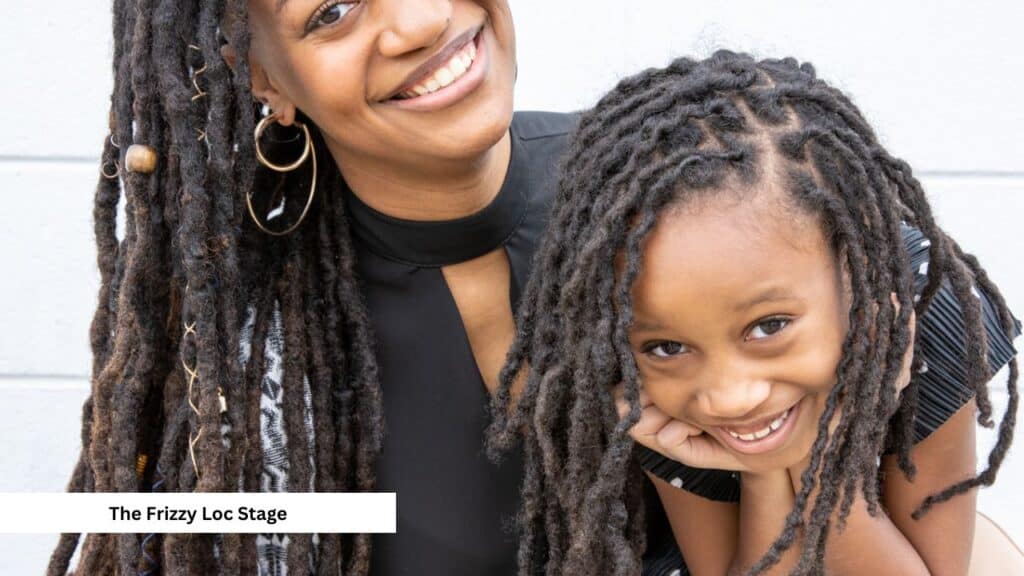
Talk to anyone who has been through the loc journey long enough, and they will tell you about the frizzy stage. Not with nostalgia exactly, more with the particular kind of relief that comes from surviving something you were not prepared for.
The frizzy loc stage is one of the most universally experienced parts of the loc journey and also one of the least honestly discussed.
Before you start locs, the content you consume tends to show two versions of the story: the beginning, where your starter locs look neat and intentional, and the end, where your mature locs are long, defined, and beautiful. The messy, frizzy, in-between chapter rarely makes the highlight reel.
This article is about that chapter. What it actually is, why it happens, what most people get wrong when they try to fix it, and what the loc community has quietly learned about the only approach that truly works.
***Please note that this site uses affiliate links if you would like to read the legal stuff you can find it here
What the Frizzy Stage Actually Is
Frizz in locs is not a malfunction. It is the hair doing exactly what it needs to do in order to loc.
When the hair begins to knot and coil on itself to form a loc, it does not happen in a straight line from root to tip in one clean motion. It happens unevenly, at different points along the strand, over an extended period of time.
As sections of hair lock up and tighten, the surrounding hair that has not yet fully joined the loc sticks out. That sticking out is what we call frizz.
In loose natural hair, frizz is typically a response to humidity, dryness, or damage. In locs, frizz during the early and middle stages of the journey is structural. It is the physical evidence of locking in progress. The hair that appears to be escaping the loc is, in most cases, in the process of being absorbed into it.
Understanding this distinction changes everything about how you respond to it.
When the Frizzy Stage Happens
The frizzy stage does not arrive on a fixed schedule, but it most commonly intensifies somewhere between months three and twelve, overlapping significantly with what the loc community calls the budding and teenage stages.
In the very beginning, starter locs tend to hold their shape reasonably well because the hair has been freshly manipulated into a defined pattern. As weeks pass and the locking process begins in earnest, that initial neatness starts to give way. The roots begin to swell. The length develops texture. The carefully coiled or twisted sections start to look less like a style and more like something that has a mind of its own.
For people with looser curl patterns or finer hair textures, the frizzy stage can be more pronounced because the hair takes longer to knot and bind. For coarser textures, the stage may be shorter but no less present. Regardless of hair type, almost everyone passes through some version of it.
The Part Nobody Warns You About: How It Feels
The practical reality of the frizzy stage is one thing. The emotional reality is another, and the two are rarely discussed in the same breath.
Most people enter the frizzy stage having built up a certain amount of optimism about their loc journey. They have done the research. They have found their inspiration. They have committed to the process. Then the frizz arrives, and with it comes a specific kind of self-consciousness that is hard to explain to someone who has not experienced it.
Locs are visible. They are a choice people make in public, a style that invites attention and sometimes commentary. When your locs are in the messy, unruly phase of their development, you are wearing the in-progress version of that choice in full view of everyone around you. Family members who were already uncertain about your decision have new material to work with. Colleagues who have never had a comment before suddenly do. Social media, where everyone else’s locs seem to look effortlessly good, starts to feel like a very unfriendly mirror.
The frizzy stage tests your commitment not just to the style, but to yourself.
What Most People Try First (And Why It Doesn’t Work)
The instinct when faced with frizzy locs is to fix them. This is understandable. The fixing instinct is strong, and the internet is full of suggestions that are happy to feed it.
Heavy gels and edge controls were applied to smooth down the frizz. Wax-based products worked into the loc to flatten the surface. Constant retwisting in an attempt to train the hair back into submission. Mousse layered on top of leave-in on top of oil in the hope that something will hold the frizz down long enough to feel like a win.
Most of these approaches do not solve the frizzy stage. They delay the appearance of it temporarily while quietly making things worse underneath. Heavy products create buildup inside the loc that can slow down the locking process. Constant retwisting puts repeated tension on roots that are already working hard.
Wax, in particular, is one of the most damaging things you can introduce to a loc in the early stages because it coats the hair in a way that is extremely difficult to remove and can trap debris and moisture inside the loc over time.
The frizzy stage is not a product problem. Trying to solve it with products almost always extends it.

What the Loc Community Eventually Learns
The wisdom that experienced loc wearers eventually arrive at, often after trying everything else first, is a form of radical acceptance. The frizzy stage passes on its own timeline. The most reliable way to move through it is to leave it alone.
This does not mean abandoning loc care entirely. It means distinguishing between genuine maintenance and anxious manipulation.
Washing regularly, keeping the scalp healthy, drying locs thoroughly, and moisturising with a light oil these things support the locking process without interfering with it.
What does interfere is the constant smoothing, retwisting, product layering, and mirror checking that frizz tends to inspire.
Locs that are left to develop without excessive interference tend to come through the frizzy stage more quickly and with stronger, more defined results than locs that are over-managed during this period. The hair knows what it is doing. The hardest part of the frizzy stage, for most people, is learning to trust that.
Styling Through the Frizzy Stage Without Fighting It
Acceptance does not have to mean doing nothing with your hair. There is a difference between fighting the frizz and working around it, and the latter is both possible and genuinely helpful for getting through the stage with your confidence intact.
Protective styles that gather the locs together, high buns, and pineapple styles, loc updos, reduce the visibility of frizz without manipulating individual locs.
Wrapping the hair at night with a silk or satin scarf reduces friction that can worsen surface frizz.
Headbands and scarves worn during the day are not just practical, they are styling choices that many people come to genuinely enjoy during this stage.
The frizzy stage is also a surprisingly good time to experiment with accessories. Statement clips, loc jewellery, wraps, and bands all sit differently on locs that have some body and texture to them. The same frizz that feels like a problem in a certain light becomes a feature in the right style.
How Long Does the Frizzy Stage Last?
This is the question everyone wants a precise answer to, and the honest answer is that it varies. For most people, the most intense frizz settles down somewhere between twelve and eighteen months into the journey, though the timeline depends heavily on hair texture, maintenance habits, and how the locs were started.
What tends to happen is not that the frizz disappears all at once but that it gradually becomes less pronounced as more of the hair locks up and joins the body of each loc.
There is usually a point, often described as a kind of turning point in the journey, where you look at your locs and realise the frizz has quieted down without you noticing exactly when it happened.
That moment arrives faster for people who resist the urge to over-manipulate. It arrives slower, sometimes significantly slower, for people who spend the frizzy stage fighting it with products and constant retightening.
Final Thoughts on The Frizzy Loc Stage
Looking at the loc community broadly, the frizzy stage seems to function as something beyond just a physical phase of hair development.
It is a test of patience in a culture that is not very good at waiting. It is a confrontation with the gap between expectation and reality in a space saturated with polished, curated images.
It is an opportunity to make peace with a version of yourself that is visibly in process, unfinished, still becoming.
The people who come out of the frizzy stage with the strongest loc journeys ahead of them tend to be the ones who stopped trying to skip it. Not because suffering through it is noble, but because learning to trust the process during the hard, unglamorous middle is exactly the skill that a long loc journey requires again and again.
The frizzy stage ends. The locs that come through it are better for what they went through to get there.
Pin this to your loc journey board! 📌
Related posts: