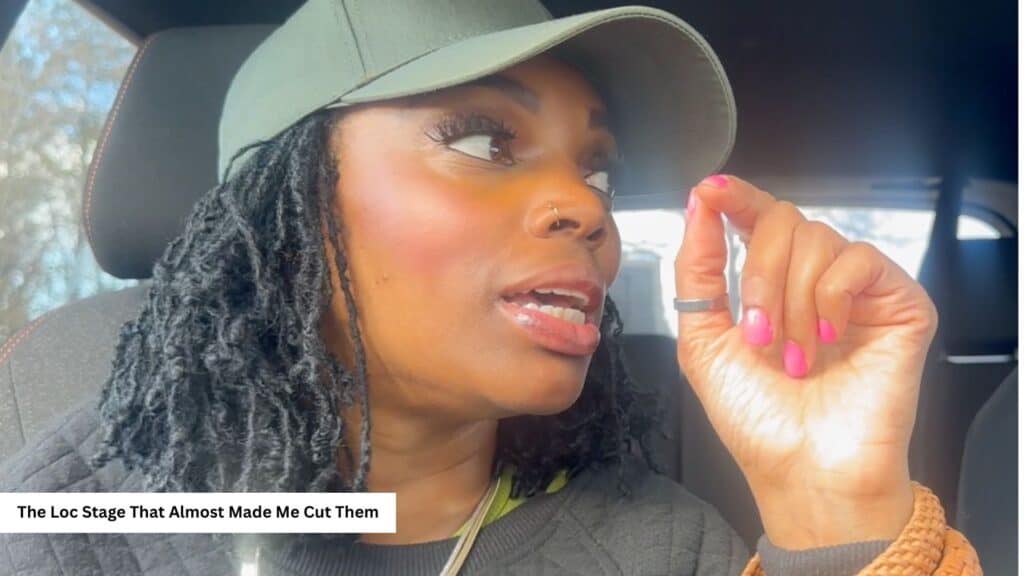
I Was This Close to Quitting
Let me paint you a picture. It’s month seven of my loc journey. I’m standing in the bathroom mirror, edges slightly fuzzy, locs somewhere between puffy and limp, not quite locked, not quite loose, just existing in this awkward in-between phase that nobody properly warned me about. My scissors were in the drawer. My patience was on the floor.
I had watched every YouTube video. I had saved every Pinterest board. I had read the blog posts that promised me my locs would be beautiful, spiritual, freeing, and they were right, eventually. In that moment, I was stuck deep in what the loc community calls the ugly stage, and I want to talk about it honestly, because I wish someone had talked to me about it the same way.
***Please note that this site uses affiliate links if you would like to read the legal stuff you can find it here
What Is the Ugly Stage of Locs?
The ugly stage, sometimes called the budding stage or the awkward phase, is the period in your loc journey where your hair has lost its starter style but hasn’t yet fully locked.
For most people, this happens somewhere between months three and nine, though it varies widely depending on your hair texture, the method you used to start your locs, and how often you’re retwisting or palm rolling.
During this stage, your locs may look frizzy, unraveled at the ends, shorter than expected (because they’re shrinking as they lock up), or just generally chaotic.
The neat, defined starter locs you were so proud of seem like a distant memory. What you’re left with feels like neither locs nor natural hair, just something in between that doesn’t photograph well and doesn’t respond to anything you try.
It is completely normal. It is also, objectively, the hardest part.
Why the Ugly Stage Hits So Hard Psychologically
Here’s what no one really talks about, the ugly stage isn’t just a physical challenge, it’s a mental one. You made a decision, likely a big one, to start your loc journey. You committed. You told people. You turned down the silk press and now your hair looks like it’s punishing you for the audacity.
The self-doubt creeps in fast.
Did I choose the wrong method? Is my hair too soft to loc? Should I have gone to a loctician? Am I even cut out for this?
Add to that the outside noise, the well-meaning family members asking “when are you going to do something with your hair,” the coworkers who suddenly have opinions, the social media pages of people six years into their journey whose locs look like something from a fairy tale, and the ugly stage becomes as much more of an emotional one.
This is the stage that separates people who end up with a long, thriving loc journey from those who cut them off and say locs “just weren’t for them.”
Not because locs weren’t right for them, but because no one helped them survive the middle part of the journey.
The Loc Stages Explained: Where the Ugly Phase Fits In
Understanding the full loc journey helps you find your bearings when you’re deep in the hard part. Most locticians break it down into roughly five stages:
1. The Starter Stage — Your locs are freshly installed, whether that’s two-strand twists, interlocks, comb coils, or sister locs. Everything looks intentional and pretty. You’re posting selfies.
2. The Budding Stage (The Ugly Stage) — The hair starts to swell and knot at the roots. The ends may unravel. Frizz increases. Definition decreases. This is where most people struggle.
3. The Teenage Stage — Your locs are locking up but they’re still unpredictable. Some may be thicker than others. They may be too short to style easily but too long to just leave alone. Still a tricky phase.
4. The Mature Stage — Locs are fully locked, smooth, and cooperating. Styles are easier, the hair has weight and movement, and you start to understand what all the fuss was about.
5. The Rooted Stage — Years in, your locs have a history. They carry your story. This is the stage people post about when they say locs changed their life.
The ugly stage is stage two, and it is the most common point of dropout for a lot of people. Knowing it has a name, and an end, can make it survivable.
What Actually Helped Me Push Through
I didn’t cut my locs. Clearly. But getting to the other side wasn’t just about willpower. Here’s what genuinely helped:
Finding A Community That Was Honest
Most loc content online shows the gorgeous end result. I had to actively seek out people documenting the middle, the bad weeks, the frizz updates, the “I almost quit” posts. That honesty was more valuable than any tip or product recommendation.
Putting The Mirror Away
I know it sounds dramatic, but I made a rule for myself, no daily mirror checks. I would look at my locs on wash day and that was it. What I couldn’t see, I couldn’t spiral about.
Learning To Style Creatively Through The Awkward
Headbands, scarves, loc wraps, high buns, not as ways to hide my locs, but as ways to play with them during a stage where they needed a little help. The ugly stage is actually a great time to experiment with accessories.
Trusting The Timeline
Every loc journey is different. Your hair texture, your starting method, your maintenance routine, all of it affects how long the ugly stage lasts. Comparing your month seven to someone else’s month seven is a recipe for despair.
Booking A Session With A Loctician
Sometimes a professional retwist and a conversation with someone who has seen hundreds of journeys through this stage was all I needed. Having someone look at my locs and say “these are locking beautifully, you’re right on track” could be worth it.

Common Ugly Stage Questions Answered
How long does the ugly stage of locs last?
For most people, the ugly stage lasts between three to six months, but it can extend longer depending on hair type and maintenance. Fine or silky hair textures may take longer to lock fully.
Can I retwist during the ugly stage?
Yes, but don’t overdo it. Over-manipulation during this phase can actually slow down the locking process. Work with your loctician to find a retwisting schedule that supports your hair without stressing it.
Why are my locs unraveling at the ends?
This is extremely common during the budding stage. The ends are often the last part of the loc to fully lock. Using a light holding product and allowing them to dry fully after washing can help.
Is it bad to wash locs during the ugly stage?
Absolutely not, in fact, washing is important for healthy loc formation. The key is drying your locs thoroughly after washing. Wet locs left to air dry slowly can develop buildup or mildew, especially in the budding stage when they’re thickest in the middle.
Final Thoughts on The Loc Stage That Almost Made Me Cut Them Off
I’m writing this article with locs that are now well past the ugly stage. They have weight. They swing when I walk. They hold styles I used to only see on Pinterest boards. When I look at them now, I can trace the months of uncertainty right into the confidence I feel today.
The stage that almost made me cut them off is also the stage that made me certain I never would because pushing through the ugly part, the part nobody posts about, the part that tests your patience and your commitment and your identity, that is where the real journey happens.
If you are in the ugly phase right now, stick with it. Wrap your hair, laugh at the frizz, find your community, and trust the process. The locs you’re dreaming of are forming underneath all that chaos.
They’re coming. I promise.
Save this post on Pinterest for your loc journey inspo board! 📌
Related posts:
Why your 4b Locs are taking a long time to loc