Losing your edges is not just a hair problem. For a lot of us, it carries weight that goes beyond aesthetics.
Our edges are tied to how we feel when we look in the mirror, to how put-together we feel stepping out of the house, to a kind of confidence that is hard to explain to someone who has never experienced thinning along their hairline.
So if you are reading this because your edges are struggling, I see you, and I want you to know there is a real path forward.
I watched my own edges start to thin over time and convinced myself it was just genetics, just stress, just the way my hair was. It was not.
It was a combination of things I was doing and not doing that I had the power to change. Once I changed them, my edges came back. Slowly, but they came back.
This is exactly what I did.
***Please note that this site uses affiliate links if you would like to read the legal stuff you can find it here
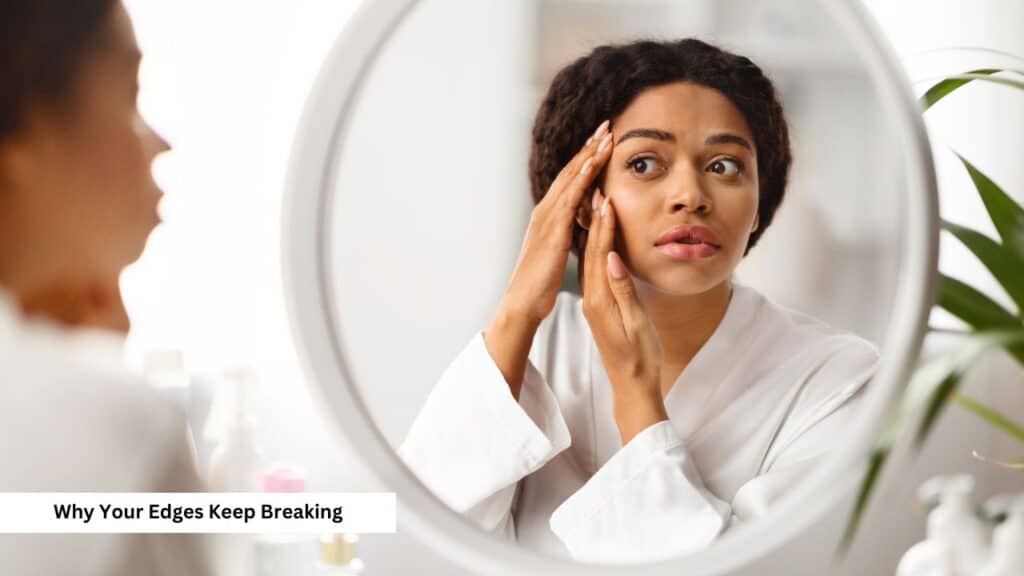
First, Let’s Talk About Why Edges Break in The First Place
Your edges, the fine, delicate hair at your hairline, are structurally different from the rest of your hair. The strands are thinner, the follicles are more sensitive, and the skin at the hairline is under more tension than most other areas of your scalp. That combination makes edges uniquely vulnerable.
The most common causes of edge breakage and thinning are tension, dryness, manipulation, and neglect. Often, it is not one of these in isolation but a slow accumulation of all of them over time. A tight style here, a skipped moisture routine there, an edge control applied daily without ever cleansing the hairline, none of it feels catastrophic in the moment, but it adds up over time.
Traction alopecia hair loss caused by repeated tension on the follicle is one of the leading causes of permanent edge loss in black women. The word permanent matters here. Once a follicle is damaged beyond recovery, the hair it produces is gone. This is why addressing the problem early, before scarring occurs, is so important.
The Tension Problem: Styles That Cost More Than They Give
This was the hardest thing for me to accept because I loved my protective styles. Braids, twists, weaves, sleek buns, all of it and all of it, done too tightly or too frequently, was slowly damaging my edges.
Here is what I had to learn, a style being popular or widely recommended does not mean it is safe for your edges.
Styles that pull the hairline tightly, that use rubber bands directly on fine hair, that are kept in for longer than they should be, or that are installed by someone who does not take the tension at your edges seriously. All of these are risks.
The rule I now follow without exception is that if a style hurts when it is first done, it is already too tight. Pain is not a sign that it will loosen and be fine. Pain is a sign that the follicle is under stress right now. Taking down a style that hurts and having it redone at a reasonable tension is always the right call, no matter how inconvenient it feels in the moment.
What I Stopped Doing First
Before I talk about what I added to my routine, I want to talk about what I removed, because this was actually where the most significant change happened.
I stopped using edge control products daily. Most edge control products contain alcohol and heavy-holding agents that dry out fine hair over time. I was applying them every single day to lay my edges, and every single day I was stripping moisture from the most fragile part of my hairline. I switched to using edge control sparingly, only for specific occasions, and only ever followed by a gentle cleanse within a day or two.
I stopped sleeping without protecting my hair. A cotton pillowcase was quietly working against me every night, absorbing moisture and creating friction along my hairline while I slept. A satin bonnet, a silk pillowcase, or a satin-lined cap became non-negotiable. This single change made a visible difference within weeks.
I stopped ignoring tension. If something felt tight, I said so. If it still felt tight after being adjusted, I took it out. My edges were worth more than the style.
The Routine That Finally Made The Difference
Once I cleared out the habits that were causing damage, I built a simple routine focused entirely on nourishment and gentleness. This is what I did.
Cleansing the hairline properly. Product buildup at the hairline blocks follicles and contributes to inflammation. I started making sure my hairline was thoroughly but gently cleansed on every wash day, using my fingertips rather than scrubbing, and following with a rinse that fully removed any residue.
A dedicated scalp oil massage at the hairline. Every few days, I apply a small amount of lightweight oil, jojoba or castor oil diluted with a carrier such as coconut oil, directly to my hairline and massage gently using circular motions with my fingertips. This increases blood circulation to the follicle, which directly supports regrowth. Not aggressive rubbing. Gentle, intentional pressure. Two to three minutes is enough.
Keeping the hairline moisturised. Fine hair dries out faster than the rest of your hair. I started applying a small amount of water-based leave-in to my edges after every wash and sealing with a light oil, the same way I was treating the rest of my hair. I had been moisturising everything except the part that needed it most.
Giving my hairline a break from styling. There were weeks when I deliberately styled my hair in a way that left my edges completely free from manipulation. No laying, no slicking, no product. Just clean, moisturised, protected hair. Your edges need recovery time, the same way any part of your body does after stress.

On Regrowth: What To Expect And When
Edges do not come back overnight. I want to be honest about that because I think unrealistic expectations cause a lot of people to give up too soon.
Hair follicles that have been under stress but are not permanently damaged will respond to consistent care, but the timeline is measured in months, not weeks. Fuzz along the hairline is usually the first sign that follicles are responding. Fine, short baby hairs that were not there before. That is what you are looking for in the beginning, not a full, thick hairline, but evidence that something is happening.
Stay consistent. A routine that is simple and sustainable will always outperform an intensive one that you abandon after two weeks.
When to See A Professional
If your edges have been thinning for a long time, if you are experiencing significant hair loss at the hairline, or if there is any scalp inflammation, scaling, or soreness in the area, please see a dermatologist. Traction alopecia in its more advanced stages, scarring alopecia, and other conditions that affect the hairline require professional assessment and treatment. No natural hair routine alone will address those things.
There is no shame in getting professional support. Your edges deserve that level of attention.
Final Thoughts on Why Your Edges Keep Breaking
Stop pulling your edges. Stop drying them out. Stop skipping moisture at the hairline. Massage the area consistently. Protect your hair at night. Give the follicles the environment they need to do their job, and then be patient while they do it.
Your edges are not gone. In most cases, they are just waiting for you to stop working against them.
Despite what you or anyone else may think, edges can grow back if you take the timeout and follow the steps above.
Related posts:
How to tell if you have product buildup